


What Size Removal Van Do You Actually Need?

As a general rule, a 1 to 2 bed flat requires a single 3.5-tonne vehicle, though this varies based on the actual content. A 3-bed home typically demands either two 3.5-tonne vehicles or one 7.5-tonne lorry. For larger 4+ bed properties, we usually estimate a total cubic space equivalent to four 3.5-tonne vehicles, which requires a 7.5-tonne lorry combined with a second support vehicle. This guide breaks down the technicalities of vehicle capacity, local access realities, and how professional space planning ensures a seamless transition.
When planning a house move, understanding vehicle dimensions is just as critical as organising your schedule. Miscalculating this space leads to costly delays, extra fees, and major moving day stress. The exact van size you need depends entirely on the total physical volume of your belongings and local road access, not just the number of rooms.
Property Size vs Physical Volume For Your Move
A common misconception is that the number of bedrooms in a house directly corresponds to a specific vehicle size. In reality, floor space does not equal physical volume. A minimalist two-bedroom flat can easily contain fewer belongings than a heavily furnished one-bedroom property packed with books, antique furniture, and sentimental items.
Every home has a unique density. Large items such as American-style fridge freezers, three-seater sofas, and wardrobes require vast chunks of uninterrupted vehicle space. This is precisely why calculating your requirements based purely on a floor plan can lead to critical logistical failures on moving day.
Why Professional Home Surveys Are Essential for Removals
To eliminate guesswork, we rely heavily on detailed volume assessments. Professional surveys exist to calculate exact spatial footprints before any vehicle is dispatched. By evaluating the dimensions of your large furniture, estimating the total box count, and assessing awkward items, an experienced surveyor calculates the precise cubic capacity required.
Today, you do not even need to clear your schedule for an in-person visit. We provide highly accurate digital assessments, allowing you to book a convenient WhatsApp video survey. This allows us to inspect your rooms, analyse tight hallways, and view entry points in real time, ensuring we allocate the perfect vehicle and crew size to eliminate morning surprises.
Approximate Move Sizes Explained
While every home varies, understanding standard industry classifications gives you a solid baseline for your planning.
Studio or One-Bedroom Flat
Baseline Vehicle: Long-wheelbase transit vehicle.
Best Suited For: Compact living spaces with minimal furniture and a modest collection of boxes.
Service Recommendation: Utilising targeted man and van services provides the ideal balance of speed and economy.
Important Note: These vehicles generally handle minor residential transfers smoothly, provided there are no oversized appliances.
Two-Bedroom House or Flat
Baseline Vehicle: 3.5-tonne Luton van.
The Industry Workhorse: The Luton van is the standard for the residential moving sector, featuring a distinct box-shaped cargo area that sits over the driver’s cab.
Efficiency Boost: This design creates a completely flat loading bed without wheel arches obstructing your furniture, making it highly efficient for average apartments and small terraced homes.
Three-Bedroom Family Home
Baseline Vehicle: 7.5-tonne commercial truck or multiple 3.5-tonne vehicles deployed simultaneously.
Capacity Reality: A standard three-bedroom property routinely exceeds the capacity of a single Luton van.
Volume Factors: A family home naturally accumulates a significant volume of outdoor gear, bicycles, beds, and heavy kitchen appliances that require industrial-grade transit space.
Four or More Bedrooms
Baseline Vehicle: A large 7.5-tonne vehicle combined with a secondary support van, or a specialised heavy goods vehicle.
Logistical Demand: Substantial properties with four or more bedrooms demand major logistical planning.
Premium Care: When managing substantial estates, we also frequently coordinate a full packing service alongside the transit vehicles to ensure that a massive volume of fragile belongings is securely wrapped, indexed, and structurally stacked.
Understanding Cubic Footage Simply
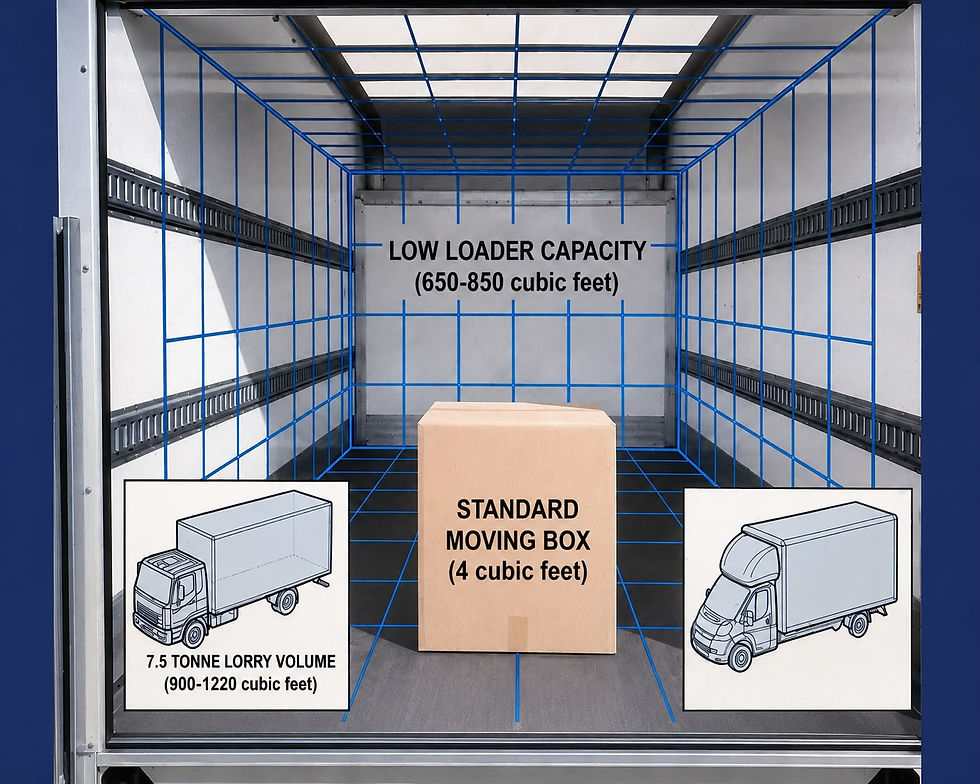
A standard 3.5-tonne panel van provides roughly 300 to 450 cubic feet of usable space, while a Luton van expands that to 550 to 650 cubic feet and a low loader offers 650 to 850 cubic feet. Moving up to a 7.5-tonne commercial lorry grants you anywhere from 900 to 1,220 cubic feet of cargo volume, making it essential for larger four-bedroom homes that easily exceed 2,000 cubic feet. Crucially, while weight limits are a major restriction for all 3.5-tonne vehicles, 7.5-tonne and 12-tonne lorries feature heavy-duty suspension systems built to handle heavy payloads effortlessly. Knowing these metrics helps convert an abstract pile of furniture into a concrete mathematical calculation.
Comparing Vehicles: 3.5-Tonnes vs 7.5-Tonnes
Selecting between these two primary vehicle tiers involves balancing capacity against physical agility.
The gross vehicle weight of a 3.5-tonne van refers to the total legal weight of the vehicle, fuel, passengers, and cargo combined. Because they are lighter, they face fewer urban driving restrictions and emission penalties.
While a 7.5-tonne truck offers double the cubic volume of a Luton van, it requires professional operating licenses and is subject to strict heavy goods vehicle regulations across metropolitan areas.
You must also watch out for the payload trap. A 3.5-tonne Luton van has a massive physical box, but its weight payload is strictly limited. Loading it completely with heavy books, tools, or dense wooden furniture can easily push it past its legal weight limit, even if it looks half-empty.
Access Restrictions Across London
This is where local geographical expertise becomes your greatest asset. Operating a transport service across historic urban areas requires a deep understanding of local infrastructure.
A massive 7.5-tonne vehicle might look great on paper for a large move, but it is entirely impractical if your property sits on the tight, historic roads frequently found throughout Kingston and Richmond. Low-hanging trees, historic stone archways, sharp corner radius, and structural bridge weight limits can completely block large commercial trucks from approaching your front door. In these specific scenarios, deploying two agile 3.5-tonne Luton vans is a vastly superior strategy to attempting to force a large lorry down an inaccessible lane.
Navigating Local Parking Limitations and Permits

Parking a large commercial vehicle in London requires precision planning. Richmond and Kingston feature extensive Controlled Parking Zones, strict yellow line rules, and narrow residential bays that cannot easily accommodate long-wheelbase vehicles.
Failing to plan for this can result in immediate council penalties or a complete halt to your moving schedule. It is absolutely vital to check local council frameworks well in advance to arrange formal parking suspensions or specific permits for moving day. Furthermore, if you are coordinating a complex office move, ensuring clear commercial loading bay access is paramount to keeping the project on schedule. Find out more in our blogpost 'Parking Permits: The essential guide for Kingston and Richmond'.
The Pitfalls of Multiple Trips vs One Large Vehicle
It can be tempting to hire a small van and simply plan to make three or four consecutive trips back and forth. However, this approach is rarely efficient.
Multiple trips multiply the time spent driving, sitting in traffic, and unloading, which quickly exhausts your moving crew. It also leaves your belongings exposed to changing weather conditions over a prolonged period. Except for incredibly short moves down the exact same street, consolidating your items into a single, correctly sized vehicle run is much safer and highly cost-effective.
Why Loading Strategy and Weight Distribution Matter
How a vehicle is packed is just as important as its absolute size. Professional loading is a highly skilled discipline that protects your investments during transit.
Heavy items must always be loaded first, positioned low down along the floor bed, and distributed evenly across the axles to maintain vehicle stability. Fragile items and lighter boxes are stacked securely on top. If a van is loaded haphazardly, items will shift violently during transit, causing severe damage. Professional crews utilize specialised straps, protective blankets, and structural stacking techniques to lock every item into place.
Choosing the Right Approach for Your Move
Ultimately, the goal is a safe, efficient, and stress-free transition. Whether you are transitioning to a new home and are looking for a professional house move, shifting items into long-term storage, man and van services or moving your business premises, the vehicle configuration must match your specific volume and local environment.
Do not guess your space requirements and risk a logistical breakdown on your moving day. Contact our team today to discuss your upcoming project, or fill out our quotation form to calculate your exact volume and secure the perfect vehicle strategy for your move.
FAQ
Can a professional removal truck stop on a London red route to load?
Transport for London provides designated red or white dashed loading boxes along these routes, which typically permit continuous loading for up to twenty minutes during off-peak windows. For major residential moves that require extended loading periods or direct access outside these specific boxes, a professional removal company must apply for a formal Transport for London red route dispensation at least six working days in advance to secure legal permission.
How does a professional home survey calculate volume more accurately than an online calculator?
Online calculators rely on generic, flat multipliers that fail to consider the unique shape, density, and layout of your home. A professional home survey evaluates your exact spatial footprint by assessing unstackable items, oddly shaped furniture, loft clearings, and garden equipment that standard automated software misses entirely. Furthermore, experienced surveyors factor in the physical bulk of necessary protective packing materials, specific dismantling requirements, and local property access challenges, ensuring your allocated vehicle matches your precise technical requirements instead of an automated guess.
What are the typical physical dimensions of a standard UK Luton van?
A standard 3.5-tonne UK Luton van features a spacious box-style cargo area that sits directly over the driver cab to maximise room. The internal dimensions of the load space typically measure between 4.0 and 4.3 metres in length, 2.0 to 2.1 metres in width, and 2.2 to 2.4 metres in height. This layout creates a total loading capacity of roughly 650 to 850 cubic feet, which equates to approximately 17 to 22 cubic metres of physical volume. The legal payload capacity generally ranges from 800 to 1,200 kilograms, and these vehicles are routinely fitted with a 500-kilogram hydraulic tail lift to handle heavy household appliances safely.


Comments